
Skills and abilities are often used interchangeably, yet they have distinct meanings, both playing a critical role in the personal and professional development of individuals. Understanding the difference between skills and abilities is essential to upholding the right mindset, especially in career growth and success. But how to differentiate between the two? This article uncovers the significant difference between skills and abilities after defining each of these terms, major skills and abilities contributing to professional growth, and tips for enhancing them. Read on!
What are Skills?
Skills are learned or acquired capabilities developed through life, training, practice, and experience that prepare individuals to perform specific tasks effectively. Skills are generally categorized as hard skills and soft skills with the former being technical or job-specific and the latter interpersonal and behavioral traits. Individuals must possess skills to perform their duties effectively and adapt to challenging situations in the workplace. To stay updated and relevant in the competitive business space, it is imperative to focus on continuous development of skills.
What are Abilities?
Abilities, unlike skills, are innate talents possessed by a person that form the foundation for skills to be built upon. In other words, the ability is the potential to build skills and determine the extent to which someone can attain certain skills. Although innate, some abilities can be improved or refined but less trainable. Abilities can be broadly classified as cognitive, physical, and emotional, influencing a person’s potential. In a professional setting, abilities perform a key role in determining how naturally and efficiently employees can learn and apply certain skills.
Major Skills and Abilities Needed in Workplace
Skills required in a professional scenario vary from person depending on the roles they perform. However, there are several key skills commonly seen in organizations associated with various roles and departments. Regarding abilities, while the relevance of specific abilities may vary, there are several core abilities needed in the workplace.
Different Skills for Professionals
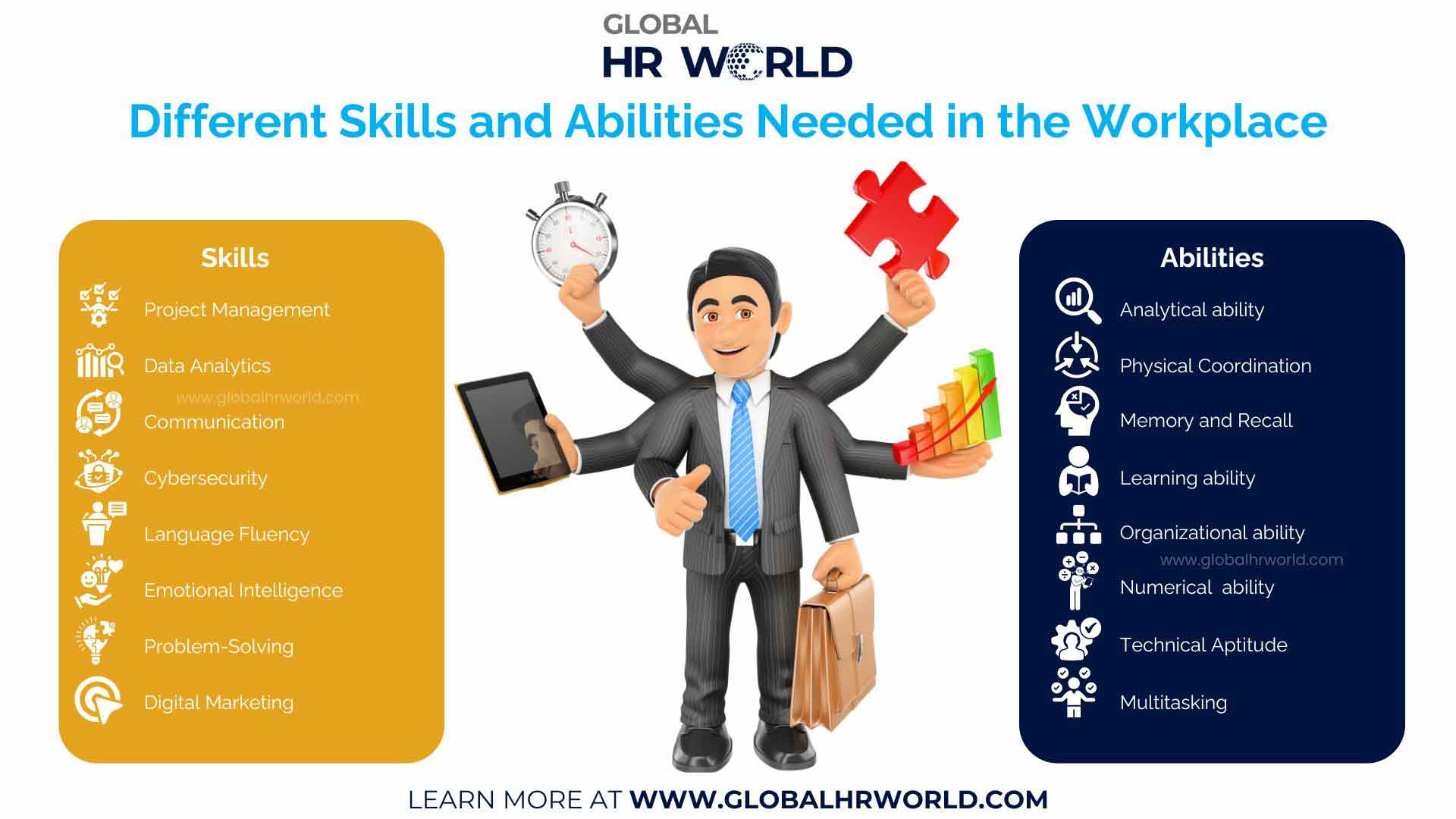
To attain success in the workplace, professionals should possess both hard and soft skills. Hard skills are technical or job-specific skills that help individuals perform tasks. Some examples of hard skills are project management, data analytics, graphic design, editing, accounting, digital marketing, cybersecurity, language fluency, video editing, coding, programming, etc. On the other hand, soft skills are personal attributes and interpersonal skills enabling individuals to interact with others and manage their work. Common soft skills required in the workplace are communication, emotional intelligence, adaptability, time management, problem-solving, collaboration, creativity, persuasion, adaptability, strategic thinking, and leadership.
Different Abilities for Professionals
Professionals possess certain innate abilities upon which they build for performing tasks effectively and responding to situations. Common abilities include analytical ability, physical coordination, memory and recall, learning ability, organizational ability, numerical ability, technical aptitude, multitasking, and coordination.
Difference Between Skills and Abilities
Understanding the key difference between skills and abilities is important to offer training on skill development and utilizing abilities into beneficial skills. Here is a breakdown of the difference between skills and abilities.
Difference Between Skills and Abilities #1: Attainment
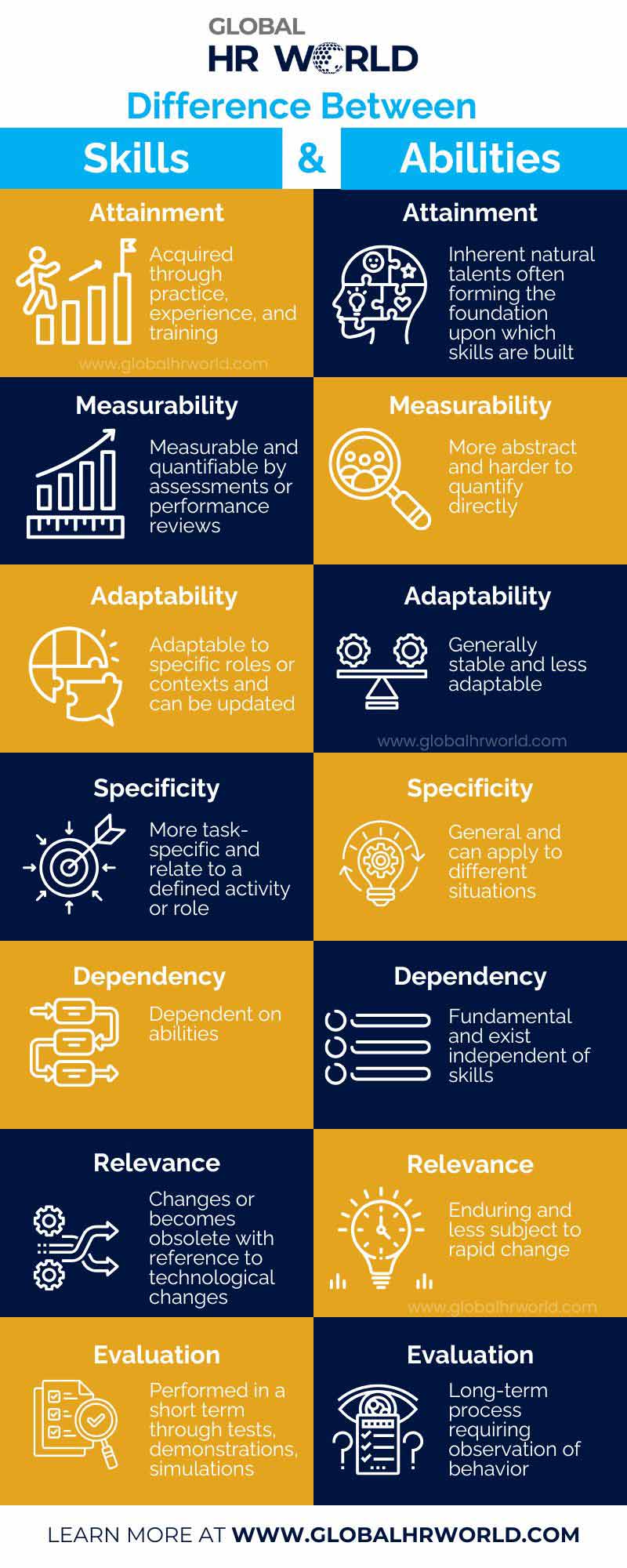
The significant difference between skills and abilities is that skills are acquired through practice, experience, and training while abilities are inherent natural talents often forming the foundation upon which skills are built.
Difference Between Skills and Abilities #2: Measurability
Skills are easily measurable and quantifiable by conducting assessments, tests, or performance reviews. On the other hand, abilities are more abstract and harder to quantify directly but are assessed through observation.
Difference Between Skills and Abilities #3: Adaptability
In terms of adaptability, skills tend to be adaptable to specific roles or contexts and they can be updated or upgraded with technological advancements or job demands. Abilities are generally stable and less adaptable.
Difference Between Skills and Abilities #4: Specificity
Regarding specificity, skills are more task-specific and relate to a defined activity or role. Abilities are general and can apply to different situations and are transferable across different job domains.
Difference Between Skills and Abilities #5: Dependency
Skills are dependent on abilities. For instance, a person attaining the skill of accounting is dependent on the learning ability of the person. However, abilities are fundamental and exist independent of skills.
Difference Between Skills and Abilities #6: Relevance
Relevance of the skills, especially technical ones changes or becomes obsolete with reference to technological changes, tools, or job changes. Abilities on the contrary are more enduring and less subject to rapid change.
Difference Between Skills and Abilities #7: Evaluation
Evaluation of skills is performed through tests, demonstrations, simulations, or performance and can be performed in a short time frame. On the other hand, evaluating abilities is a long-term process requiring observation of behavior and adaptability patterns.
Tips for Enhancing Skills in Professional Roles
Enhancing skills is essential for staying relevant and contributing meaningfully to the organization. Here are some practical tips that benefit in enhancing skills suiting professional roles.
- Conduct a skill gap analysis to prioritize the needs and guiding learning efforts.
- Create a personalized learning plan outlining the goals and objectives based on gap analysis.
- Create training programs, implement it, monitor the progress as an organization and engage in effective training as employees.
- Offer and practice shadowing techniques and practice deliberately.
- Implement job rotation in the organization to elevate skills.
- Conduct a SWOT analysis and reflect on situations.
- Promote creative and constructive discussions.
- Leverage technology for skill development.
Enhancing skills and abilities is an ongoing journey that contributes to growing professionally. Apart from offering formal and informal training, paving the way for meaningful thought and reflection is vital.
Conclusion
In both personal and professional contexts, understanding the distinction between skills and abilities is crucial for meaningful growth and success. While skills are acquired through experience and training, abilities form the inherent foundation upon which those skills are built. Skills are learned or acquired through training, experience, and practice, enabling individuals to carry out specific tasks with proficiency. These are often divided into hard skills such as data analysis, programming, and accounting, which are technical and job-specific, and soft skills like communication, adaptability, and teamwork which relate to interpersonal and behavioral qualities.
On the other hand, abilities refer to the natural, often innate, traits that a person possesses, such as analytical thinking, memory, coordination, or learning aptitude. The difference between skills and abilities lies in several aspects such as attainment, measurability, adaptability, specificity, dependency, relevance, and evaluation. Understanding the distinction between skills and abilities is crucial in identifying development needs, preparing effective training strategies, and maximizing professional potential. By analyzing gaps, leveraging training and technology, and encouraging thoughtful reflection, professionals can enhance their capabilities and remain resilient and competitive in their workplace.
Infographic
Knowledge Check!
Frequently Asked Questions (FAQs)
What are skills?
Skills are learned or acquired capabilities developed through life, training, practice, and experience that prepare individuals to perform specific tasks effectively.
What are abilities?
Abilities, unlike skills, are innate talents possessed by a person that form the foundation for skills to be built upon. In other words, the ability is the potential to build skills and determine the extent to which someone can attain certain skills.
What is the difference between skills and abilities?
The difference between skills and abilities lies in several aspects. In terms of attainment, skills are developed through learning, while abilities are typically inherent. Skills are measurable and can be evaluated through assessments, tasks, or simulations, whereas abilities are abstract and often observed over time.
Skills are adaptable to changing job roles and technologies, while abilities tend to remain stable. Skills are more task-specific, while abilities are broad and transferable. Furthermore, skills often depend on underlying abilities. For instance, the ability to analyze or learn quickly supports the development of skills like coding or strategic planning. While the relevance of skills can diminish over time due to technological advancements or shifting job requirements, abilities are more enduring and resilient to such changes.